Handwashing stations are required wherever workers apply paints, coatings, herbicides or insecticides under OSHA 1926.51(f)(1), and general worksites still need potable water under OSHA 1926.51(a)(1). San Tan Valley construction crews, event sites and farm operations all fall under one of these rules depending on the work.
OSHA splits this into two buckets and mixing them up gets crews cited. General construction sites need an adequate supply of potable water on hand, per OSHA 1926.51(a)(1), full stop, no contaminant needed. But if your crew is spraying paint, applying coatings, handling herbicides or using insecticides, that triggers OSHA 1926.51(f)(1) specifically, which calls for washing facilities near the work. It is not a blanket handwashing law, it is tied to those exposures. Separately, 29 CFR 1910.141(d)(2) requires soap and towels or a hand-drying device at washing stations, and hand sanitizer alone does not satisfy it. That single line trips up more San Tan Valley job sites than anything else on this page. If you are staging a portable sink rental next to a handwashing station rental, make sure soap and towels are actually stocked, not just a sanitizer pump. Farm operations have their own standard entirely: OSHA 1928.110 requires potable water, toilets and handwashing for hand-labor employees, at one facility per 20 workers, reachable within a quarter mile walk. That matters for farm and agricultural restrooms work around San Tan Valley, where fields can stretch well past that radius from a single unit.
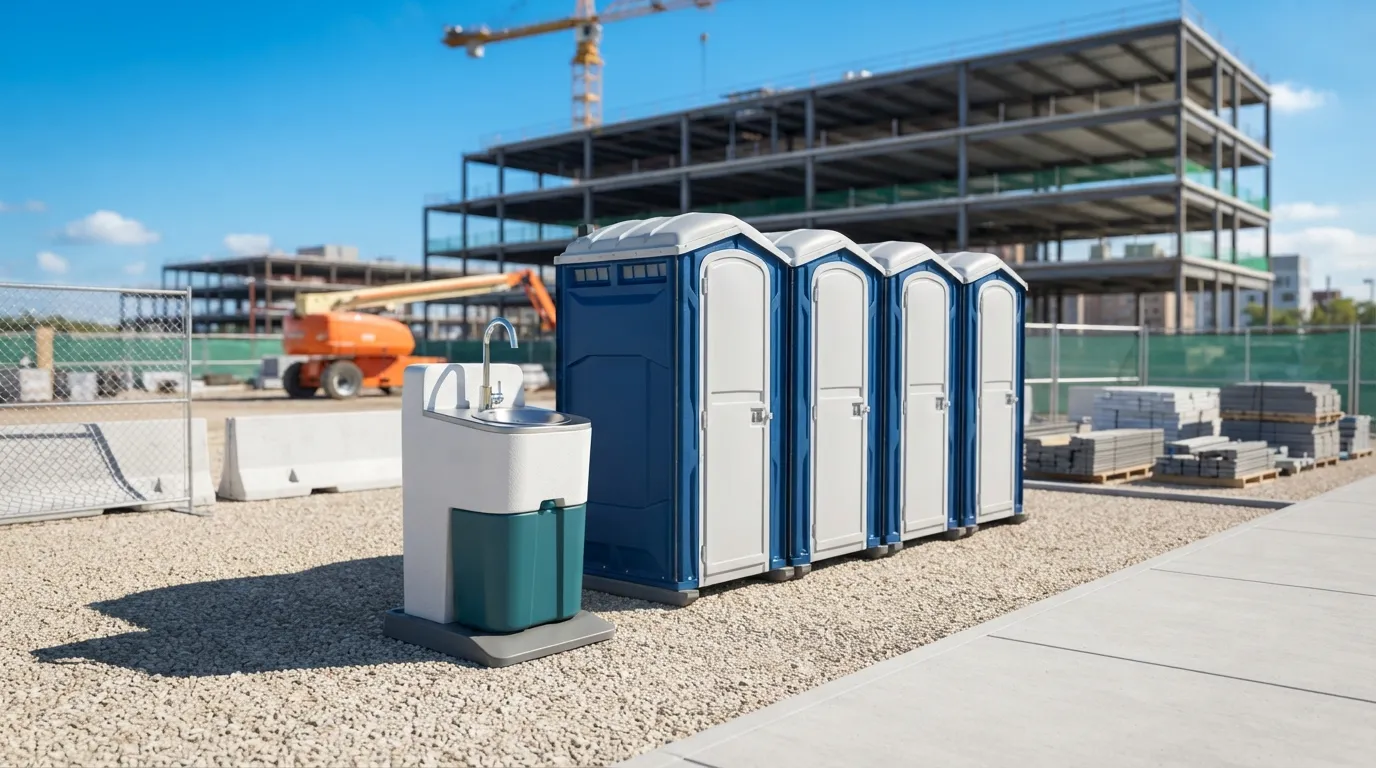
Match your handwashing count to your toilet count and your crew size, not a guess. OSHA 1926.51(c) sets toilet ratios at one facility for 20 workers or fewer, then one toilet seat and one urinal per 40 workers once you pass 20, and per 50 once you hit 200 or more. Most contractors pair a handwashing station with each toilet cluster rather than running the numbers separately, which keeps construction site services simple to plan and simple to inspect. If your crew works with paint or chemical treatments anywhere on site, OSHA 1926.51(f)(1) still applies to that specific task even if the rest of the crew never touches a sprayer. A single hand sanitizer station rental can supplement, but it cannot replace a proper soap-and-towel setup under 1910.141(d)(2). For general industry sites, not construction, the ratios come from OSHA 1910.141(c)(1)(i) instead. Know which standard covers your site before you order.
Placement is not decorative, it is functional. Stations need to sit close enough to the toilets and the work area that people actually use them, and the route in has to be walkable, not blocked by materials or debris. ADA Standards section 403.5.1 sets a 36 inch minimum clear width for an accessible route, and where portable toilets are clustered, ADA Standards section 213.2 requires at least 5 percent of units to be accessible, never fewer than one. Pair your ADA accessible porta potty with an accessible handwashing station on the same clear path. A 60 inch turning circle under ADA Standards section 304.3.1 matters here too, especially on tighter event footprints. OSHA 1926.25 also requires clearing scrap and debris from work areas, which doubles as a reason to keep the path to your handwashing requirements station clean. If you are also running a temporary fence rental around the perimeter, leave a gap wide enough for the crew to reach washing facilities without a detour.
Yes, in most working environments, and standard units alone do not satisfy OSHA's washing facility language even when they include a hand sanitizer dispenser. A standard porta potty rental handles waste, but 29 CFR 1910.141(d)(2) calls for soap and towels or a drying device, which most standalone units do not carry. Upgrading to a deluxe flushable porta potty sometimes includes a small sink, but check the unit specs before assuming. For larger crews or events, a dedicated restroom trailer rental with built-in sinks solves this cleanly, since a 4 stall restroom trailer or 8 stall restroom trailer typically includes running water at each stall. Grease-heavy operations have their own trigger point too: a grease interceptor gets pumped once fats, oils, grease and solids reach 25 percent of the liquid depth, which is worth knowing if your site runs a kitchen trailer alongside restrooms and needs grease trap pumping on schedule.
No. 29 CFR 1910.141(d)2) specifically requires soap and towels or a hand-drying device at washing facilities, and hand sanitizer does not meet that standard on its own. A hand sanitizer station rental works well as a supplement near entrances, but it cannot replace the required setup near toilets or work areas covered by OSHA 1926.51.
Whenever workers apply paints, coatings, herbicides or insecticides, OSHA 1926.51(f)(1) requires washing facilities nearby. This is narrower than general sanitation rules. A crew painting a fence line in San Tan Valley needs washing access even if the rest of the site only needs standard toilets under 1926.51(c).
OSHA does not set one blanket distance for construction, but agricultural work under OSHA 1928.110 requires a facility within a quarter mile walk. For construction and events, keep stations close enough that workers use them without cutting through debris, consistent with the housekeeping standard in OSHA 1926.25.
Yes, especially with food service or vendors handling cash and product. Pair an event restroom rental with a handwashing station at the same location. Weddings, festivals and county fair setups all benefit from placing sinks near food areas, not just near the restrooms themselves.
ADA Standards section 308.2.1 sets a forward reach limit of 48 inches maximum and 15 inches minimum for accessible fixtures, and section 309.4 requires operable parts usable with one hand at 5 pounds of force or less. Standard placement has no such reach or force requirement under general OSHA rules.
Yes. San Tan Valley Porta Pros delivers handwashing station requirements across San Tan Valley and the surrounding metro, with same-day and next-day drop-off available on most orders.
Pricing depends on the unit and how long you need it. See our cost breakdown and request a free quote for an exact figure.
Standard rentals include scheduled service — a pump-out, a clean, a restock and fresh deodorizer. Busy or hot-weather sites can be serviced more often.
Call now or request a free quote — clean units, on-time delivery, transparent pricing.